

Popaganda can be found anywhere you listen to podcasts


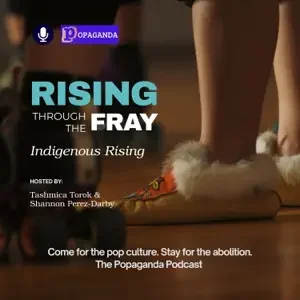
Rising Through the Fray
This special episode was made in partnership with the Capital City Film Fest, where Tashmica moderated a live panel with filmmaker Courtney Montour and skater Hawaiian Blaze following a screening of Rising Through the Fray. Courtney then joined Tashmica and Shannon to go even deeper.
Rising Through the Fray follows Indigenous Rising — the first team in roller derby history to compete at the World Cup, representing not one country but over 30 Indigenous Nations. Courtney Montour (Kanien'kehá:ka, Kahnawake) spent years building trust with the team before cameras rolled, and it shows: this is an intimate film about the disconnection caused by colonization, homecoming, and what it means to find your people on wheels.
Listen in to hear more about Sour Cherry's journey through injury and how her identity as a skater (or maybe coach) is being shaped and reshaped by time. We discuss Hawaiian Blaze's art and how it helps make the thousands of Missing and Murdered Indigenous Women (MMIW) more visible. We follow Krispy's story of discovery as she explores and connects with her nation through the team and her wider community.
Join us as we celebrate the Borderless team movement that Indigenous Rising sparked — and discuss the challenges ahead as the team continues to rise.
About Our Guest
Courtney Montour is a Kanien'kehá:ka (Mohawk) documentary filmmaker from Kahnawake, Quebec, with 18 years in the field. Her work centers women's stories, Two-Spirit stories, and the long fractures of colonial disconnection. Rising Through the Fray is her debut feature, produced with Nish Media (an Indigenous production company), and won the Audience Award for Best Documentary at image+nation Film Festival 2025.

Adult Braces: Polyamory and Minding Other People's Relationships
Shannon Perez-Darby and Tashmica Torok dig into Adult Braces, Lindy West's new memoir, Adult Braces. The internet is in a tizzy about her 15-year partnership with Aham Oluo and the process of opening their relationship. We use the word 'process' intentionally. Polyamory is only one expression of how people and the terms of their most intimate relationships can and should transform over time.
Listen in as two pop culture besties discuss what happens when the terms of a relationship changes before everyone involved is ready to stretch that far. The rupture, the repair, and the public opinions of it all.
Sponsored in part by:Accountable Communities Consortium
Access: Transcript now available on Apple Podcasts
Credits:
Executive Producers: Shannon Perez-Darby and Tashmica Torok
Audio Production: Shannon Perez-Darby
Show Notes + Graphic Design: Tashmica Torok
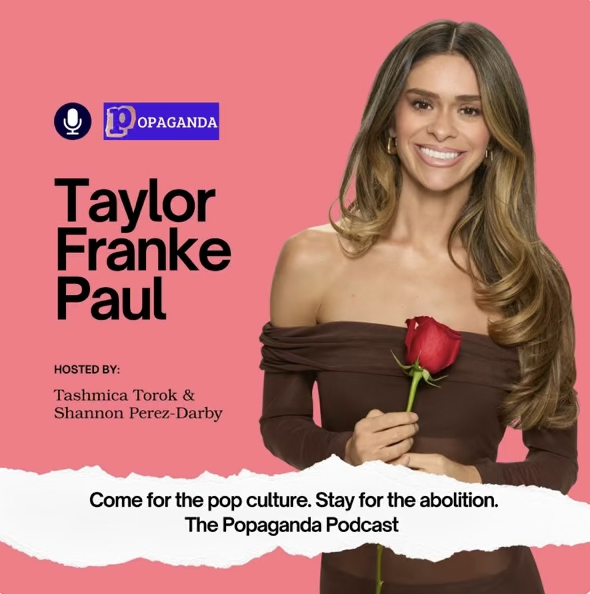
Taylor Frankie Paul, The Bachelorette, and Clocking DV Patterns in Reality TV
Days before Taylor Frankie Paul’s season of The Bachelorette was set to air, TMZ released footage of a violent incident between her and her ex, Dakota, from 2023. ABC pulled the season.
Together, Shannon and Tashmica talk through what the video shows and what it doesn’t, why one moment of volatility can’t tell us who is setting up a pattern of power and control, and who is surviving it. They unpack why the timing of the tape’s release matters. And they call out the very selective outrage of a Reality TV franchise like The Bachelor that has quietly welcomed accused abusers onto its stages season after season.
And here's the thing — we know they can do better, because they already have. In 2017, Bachelor in Paradise intervened immediately and shut down production for two weeks after a misconduct incident on set. Everyone went home. So this isn't about capability. It's about choice.
(Hint: if you want to hear more about what accountability on a reality TV set can look like — and what it costs when it doesn't show up — check out our ANTM episode: Aging Like Hot Ice Cream.)
This episode is about Taylor Frankie Paul. It’s also about every person in your life you’ve watched spiral without intervening. And it’s about what it would look like if we actually cared about getting this right.
Come for the Pop Culture. Stay for the Abolition.Sponsored in part by:Accountable Communities Consortium
Access: Transcript now available on Apple Podcasts
Credits:
Executive Producers: Shannon Perez-Darby and Tashmica Torok
Audio Production: Shannon Perez-Darby
Show Notes + Graphic Design: Tashmica Torok

adult braces: polyamory and minding other people’s relationship
Shannon Perez-Darby and Tashmica Torok dig into Adult Braces, Lindy West's new memoir, Adult Braces. The internet is in a tizzy about her 15-year partnership with Aham Oluo and the process of opening their relationship. We use the word 'process' intentionally. Polyamory is only one expression of how people and the terms of their most intimate relationships can and should transform over time.
Listen in as two pop culture besties discuss what happens when the terms of a relationship changes before everyone involved is ready to stretch that far. The rupture, the repair, and the public opinions of it all.
Come for the Pop Culture. Stay for the Abolition.Sponsored in part by:Accountable Communities Consortium
Access: Transcript now available on Apple Podcasts
Credits:
Executive Producers: Shannon Perez-Darby and Tashmica Torok
Audio Production: Shannon Perez-Darby
Show Notes + Graphic Design: Tashmica Torok
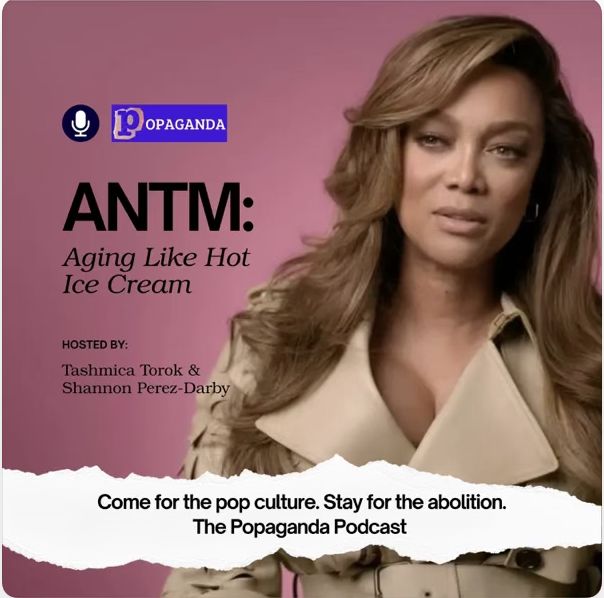
ANTM: Aging like hot ice cream
What does it mean when the person who built the door is also the one controlling who walks through it? Netflix's Reality Check: Inside America's Next Top Model pulls back the curtain on two decades of harm styled as opportunity—and Shannon and Tashmica are not letting Tyra off the hook.
This docuseries revisits the 2003–2018 run of America's Next Top Model through interviews with Tyra Banks, co-hosts Miss J, J. Manuel, and Nigel Barker, and several former contestants candidly telling their stories.
Tyra's current legacy project is hot ice cream. Which is, technically, incomplete ice cream. Tashmica has notes.
Shandy is a cycle two contestant whose sexual assault—filmed by the crew while she was too intoxicated to consent—was edited and broadcast as a cheating scandal.
Tyra Banks is the creator, executive producer, and subject of this documentary—a woman whose access to power has not translated into accountability, solidarity with Black women, or care for the people she claims to have uplifted.
And the industry is doing what it always does: making the person who was harmed responsible for the story.
What we keep coming back to:
Shandy's story is an example of how the production team transformed an assault into a scandal—in real time, before she even understood what had happened to her
The "diversity" Tyra built was a pinprick, not a door—and the show's own alumni confirm their careers were hurt, not helped, by being on it
What Bachelor in Paradise did differently in 2017 shows exactly what it looks like to prioritize people over timelines—and how rare that actually is
Leaving us with: when someone uses their power to control who else gets in—and whose stories get told—are they opening the door, or are they the lock?
Content note: Sexual violence, anti-Black racism and colorism, disordered eating, dental coercion, stroke and disability discussed.
Pop Culture Homework:
Watch: Reality Check: Inside America's Next Top Model (Netflix)
Come for the Pop Culture. Stay for the Abolition.Sponsored in part by:Accountable Communities Consortium
Access: Transcript now available on Apple Podcasts
Credits:
Executive Producers: Shannon Perez-Darby and Tashmica Torok
Audio Production: Shannon Perez-Darby
Show Notes + Graphic Design: Tashmica Torok
baftas and bbc broadcast the n-word—on purpose?
In this special short episode of The Popaganda Podcast, hosts Shannon Perez-Darby and Tashmica Torok talk about the BAFTAs moment that hit Michael B. Jordan and Delroy Lindo in real time. The N-word was shouted by John Davidson, whose life inspired a nominated film, and who has Tourette Syndrome with coprolalia—meaning the slur was an involuntary tic, not an intentional act.
Listen in as we talk about why the first take isn’t always the best take, how anti-Blackness and ableism shaped the public reaction, and why the real power here sits with BAFTA/BBC production choices—including what was reportedly edited out, and what was left in.
We refuse to let this moment eclipse the art: “Sinners” deserves celebration. It’s not just an award-winning film. It is an iconic culturally rich film that puts Black talent, historical experience, storytelling, and imagination
Pop Culture Homework
Watch: Sinners, featuring Michael B. Jordan and Delroy Lindo with Black American Sign Language (BASL) Performer Nakia Smith
Watch: I Swear, based on the true life story of John Davidson
Follow: @killk1yoshi on Instagram for more awareness content
Come for the Pop Culture. Stay for the Abolition.Sponsored in part by:Accountable Communities Consortium
Access: Transcript now available on Apple Podcasts
Credits:
Executive Producers: Shannon Perez-Darby and Tashmica Torok
Audio Production: Shannon Perez-Darby
Show Notes + Graphic Design: Tashmica Torok
pluribus
What if the apocalypse showed up… as excellent customer service?
In this episode of The Popaganda Podcast, survivor activists Shannon Perez-Darby and Tashmica Torok bring pop culture obsession and Transformative Justice-flavored analysis to Pluribus (Apple TV+), Vince Gilligan’s sleek, unsettling sci-fi series starring Rhea Seehorn as novelist Carol Sterka—a woman who becomes the world’s least willing VIP.
The premise: an alien virus transforms most of humanity into a calm, coordinated hive mind with one main hobby—politely assimilating everyone. Carol is one of 13 immune people, which means she gets to process catastrophic loss while an entire city of synced-up humans keeps saying her name like an HR training video: “Hi, Carol.”
(Respectfully: no.)
Carol survives the mass “switch up” that turns most of humanity into a calm, coordinated hive mind—while her personal world collapses, leaving her cycling through a full range of complex human emotions. Somehow, the internet’s hot take is: she’s too mad.
We dig into the show’s central seduction—and its menace: the hive mind is efficient and nonviolent, restoring order so smoothly it’s almost soothing—until you notice what it can cost in privacy, culture, and self-determination. But to Carol’s shock, not everyone experiences “collective” as the ultimate threat.
Then the season drops its most abolition-adjacent, TJ beat: after harm happens, the hive doesn’t retaliate. It doesn’t cage. It doesn’t escalate. The virus sets a boundary that reaches for safety and healing rather than punishment.
Leaving us with an important question: what could our world look like if we built responses to harm that keep people alive and cared for—while actively limiting the conditions that allow more violence to happen?
Pop Culture Homework
Pay attention to: the moments when “care” feels soothing… and when it starts to feel like control
Report back: Are you Team Carol (absolutely not) or Team “okay but the infrastructure is kind of impressive”?
Sponsored in part by: Accountable Communities Consortium
Access: Transcript now available on Apple Podcasts
Credits:
Executive Producers: Shannon Perez-Darby and Tashmica Torok
Audio Production: Shannon Perez-Darby
Show Notes + Graphic Design: Tashmica Torok
Virginia guiffre told you
In this episode of The Popaganda Podcast, survivor activists Shannon Perez-Darby and Tashmica Torok bring intimate storytelling and expert analysis to Virginia Giuffre’s posthumously published memoir, Nobody’s Girl: A Memoir of Surviving Abuse and Fighting for Justice.
Before “release the Epstein files” became the public’s favorite internet punchline, Giuffre was a teenager trying to escape her father’s sexual and physical abuse by running away—only to find herself working for Donald Trump at Mar-a-Lago. She became one of the most prominent survivors to share detailed accounts of how Ghislaine Maxwell and Jeffrey Epstein targeted, groomed, and sexually abused children—then trafficked them through Epstein’s network of rich, powerful global leaders and celebrities, including Prince Andrew Mountbatten-Windsor.
Tashmica and Shannon wade through the public’s performative shock and unproductive political theater to center one simple, devastating question: Why did we ignore the truth that survivors have been telling us for years?
As more unredacted files are released to the public, the justice promised by the criminal legal system only gets more elusive. The details are horrific, triggering, and retraumatizing for survivors of sexual violence—but don’t worry: this is not your typical true crime wrap-up.
Listen in as two pop culture besties who also happen to be survivors share survivor-to-survivor care and truth-telling, connecting Nobody’s Girl to the systems that enable harm, use children as political leverage, and prop up a criminal legal system that can’t—and won’t—ever live up to the hype.
Pop Culture Homework:
Read: (or listen): Nobody’s Girl: A Memoir of Surviving Abuse and Fighting for Justice
Read: “Sex Trafficking Prosecutions Won’t Stop the Next Epstein. Here’s What Will.” (Truthout)
Revisit: our episode on Sound of Freedom + how Christian nationalist anti-trafficking narratives shape public “common sense”
Revisit: our Wayward conversation + the troubled teen industry connections that show up here
Reflect: what would it mean to treat child safety like an emergency at scale—not a scandal, not a spectacle, not a campaign prop?
Sponsored in part by: Accountable Communities Consortium
Access: Transcript now available on Apple Podcasts
Credits:
Executive Producers: Shannon Perez-Darby and Tashmica Torok
Audio Production: Shannon Perez-Darby
Show Notes + Graphic Design: Tashmica Torok
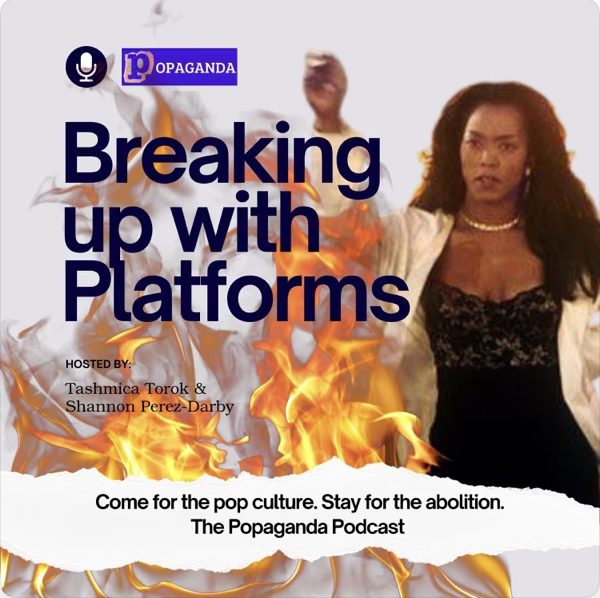
breaking up with platforms: Boycotts, billionaires and fascist creeps
What happens when your comfort shows stop comforting—and your “fun little apps” start feeling like tiny extensions of state power?
In this episode, Shannon Perez-Darby and Tashmica Torok talk about how living under fascism is reshaping our relationship to pop culture, streaming, and the platforms we’ve treated like default companions. From canceling Hulu/Disney after the Jimmy Kimmel controversy (and the bigger question of what a boycott is actually asking for), to rethinking Spotify amid reports of ICE recruitment ads, we share what we’re wrestling with: values vs. convenience, visibility vs. safety, and how to stop “overstaying” in unhealthy relationships.
We also get real about grief (yes, even for a 20-year relationship with Grey’s Anatomy), the algorithmic slide into right-wing propaganda and diet-culture-as-evangelism, and why our nervous systems are demanding different kinds of stories right now—like audiobooks, games, and community-centered ways of staying connected that don’t depend on billionaire-owned platforms.
Are you in your breakup era, too? Then put on your softest sweatpants, order some takeout, and come on over for a lonely hearts club episode of The Popaganda Podcast.
Pop Culture Homework:
Listen: Dungeon Crawler Carl (audiobook)
Watch: No Other Land and support Masafer Yatta.
Reflect: What platform or subscription are you “overstaying” with—and what would a clean, loving exit look like?
Sponsored in part by: Accountable Communities Consortium
Access: Transcript now available on Apple Podcasts
Credits:
Executive Producers: Shannon Perez-Darby and Tashmica Torok
Audio Production: Shannon Perez-Darby
Show Notes + Graphic Design: Tashmica Torok